Showing posts with label James Grant. Show all posts
Showing posts with label James Grant. Show all posts
Monday, July 18, 2011
US debt crisis is contrived, says Jim Grant
The US debt crisis is a contrived political showdown, James Grant tells Bloomberg TV. If you want a real crisis, look to Europe, says Grant.
Also up for discussion: the 30 year bull market in US Treasuries and the risks associated with government paper. Plus, the future of monetary arrangements and the gold standard vs. the "Phd standard". Enjoy the clip.

Wednesday, April 20, 2011
Wealthtrack interview with James Grant
Grant's Interest Rate Observer founder, Jim Grant sits down with Consuelo Mack for an interview on WealthTrack.
Topics include: the rising cost of living and commodities, the US dollar's decline, and the Federal Reserve's targets for "desired inflation". See what Grant has to say about all this, and more, in this discussion.
By the way, I don't think anyone who caught Grant's interview or Michael Burry's recent talk on America's financial condition was surprised by S&P's recent warning on America's AAA debt rating. Only the timing of the outlook revision might have come as a surprise, and even that may have been telegraphed to market participants earlier.
Related articles and posts:
1. Jim Grant and John Hathaway chat with Charlie Rose.
2. Jim Grant's latest interview with King World News.
3. Lew Rockwell and Jim Grant discuss Austrian economics, gold standard.
Tuesday, December 28, 2010
Finance Trends: The Best of 2010

We're wrapping up some of your favorite posts (and mine) for this Finance Trends "Best of 2010" features edition.
You'll find key interviews with leading businessmen and investors, along with the best of this year's posts emphasizing the strong trends and events that are shaping our country, our investment markets, and our world.
Without further ado, here are some key posts highlighting the big picture trends we've witnessed in 2010, some of which may continue to unfold in 2011 and beyond.
1. On a Return to Classical Education. Your educationally-deprived editor muses over the benefits of a Classical education, and how such a foundation in thinking might help us as investors and as citizens of the world.
2. Marc Faber: Final Crisis Yet to Come. Wonderful presentation by Marc at this year's Mises Circle in NYC, offering a crucial take on US monetary policy and the likely outcomes of the Fed's "quantitative easing" experiments. Video and presentation slides included.
3. Niall Ferguson on Fiscal Crises and Imperial Collapse. Must hear presentation from Ferguson offers a historical overview of government debt crises. Highly relevant back in May and only more so now that the developed nations' sovereign debt crisis continues to unfold here at year-end 2010.
4. LTCM and the Lessons of Failure. Thoughts on hedge fund collapses (and fund manager resurrections), the money manager merry-go-round, risk management, and the dangers of overconfidence.
5. Must Hear Interview with John Burbank of Passport Capital. Part of our series on global macro investors and hedge fund managers, this excellent discussion with John Burbank comes to us via Benzinga podcast.
6. Michael Burry: An Up & Coming Macro Star? An in-depth look at Michael Burry's gradual transition from a US stock-focused value investor to an international, global macro investor.
Includes an unedited transcript of Bloomberg TV's interview with Burry, in which he offers his views on the economy, investing, and his famous subprime short trade.
7. Jim Grant, John Hathaway and Peter Munk sit down with Charlie Rose to discuss gold as money, the causes of the recent final crisis, and likely outcomes of Fed and government intervention in the markets.
8. John Allison on "Leadership and Values". The former CEO and Chairman of BB&T bank speaks to Virginia's Darden School of Business on the importance of adhering to a sound ethical framework and engaging in "win-win" business transactions. Excellent talk on the spirit of true capitalism and personal responsibility.
That's all for 2010. Please join us for more in 2011, as we explore the coming year's macro investing themes and future economic events.
You can keep up with us in the meantime through our real-time updates on Twitter and StockTwits or via the Finance Trends RSS blog feed. Have a Happy New Year!
*Photo credit: Floor of the New York Stock Exchange via LOC.gov.
Wednesday, December 8, 2010
Interview: James Grant & Co. talk gold with Charlie Rose

James Grant, John Hathaway, and Peter Munk sit down with Charlie Rose to discuss gold and the nature of our monetary system in this important roundtable discussion.
I was surprised and delighted to find that Grant & Co. would be Charlie's guests on Monday's program. The topic of discussion became even more newsworthy as the US dollar gold price hit a record high (in nominal terms) that same day.
But this is more than just a chat about a commodity hitting a new high. As you will see from James Grant's opening statements to Rose, gold is money and it has been for centuries. What we see in the rising gold price is a concurrent loss of faith in the viability of all paper currency systems worldwide.
This is the basic truth about gold and silver as real money and store of value that Rose and his audience need to hear.
Plus, John Hathaway, subject of one of our earliest posts, and James Grant provide some much needed counterbalance to the prevailing narrative of the 2007-2009 financial crisis and the Fed's ongoing money printing operations (aka "quantitative easing" & QE2). It's all here in this interview, one of the most important discussions I've heard at Charlie Rose's table.
Related articles and posts:
1. Lew Rockwell interviews James Grant: Austrian economics & the classical gold standard - Controlled Greed.
2. Jim Grant: Requiem for the dollar - Finance Trends.
3. The Gold Standard: an interview with Guilio Gallarotti - Finance Trends.
4. Quantitative easing explained (plain English) - YouTube via Finance Trends.
Tuesday, November 23, 2010
Links: Insider trading, minimalist traders, & more
Here's what I'm reading and checking out today:
1. John Carney says, "The government's insider trading rules are still insane!"
2. 47 mind-blowing, psychology-proven facts you should know about yourself.
3. Lew Rockwell interviews Jim Grant, of Grant's Interest Rate Observer. Topics: the classical gold standard and Austrian economics.
4. Chicago Sean's series on The Minimalist Trader is inspired reading.
5. A way to "play" Mongolia? Part of a very cool series of posts on global investing from Adventures In Capitalism.
Stop by tomorrow, we may have a very interesting interview to share with you ahead of the Thanksgiving holiday. Until then, you can catch us on Twitter and StockTwits. Ciao!
1. John Carney says, "The government's insider trading rules are still insane!"
2. 47 mind-blowing, psychology-proven facts you should know about yourself.
3. Lew Rockwell interviews Jim Grant, of Grant's Interest Rate Observer. Topics: the classical gold standard and Austrian economics.
4. Chicago Sean's series on The Minimalist Trader is inspired reading.
5. A way to "play" Mongolia? Part of a very cool series of posts on global investing from Adventures In Capitalism.
Stop by tomorrow, we may have a very interesting interview to share with you ahead of the Thanksgiving holiday. Until then, you can catch us on Twitter and StockTwits. Ciao!
Friday, November 19, 2010
The Gold Standard: an interview with Guilio Gallarotti
Wanted to share this McAlvany podcast entitled, "The Gold Standard: An Unwelcome Political Restraint. An Interview with Guilio Gallarotti".
Hat tip to Maoxian, who noted that Jim Grant recommended Gallarotti's book, The Anatomy of an International Monetary Regime: The Classical Gold Standard, 1800-1914, to better understand the workings of a gold standard monetary system.
As I said on Twitter the other night, there are some fascinating insights offered by Gallarotti in this interview, particularly in his discussion of how universal suffrage politicized economics during the 20th century. I'm sure you'll find much more of interest besides, so tune in to the interview above and enjoy.
Hat tip to Maoxian, who noted that Jim Grant recommended Gallarotti's book, The Anatomy of an International Monetary Regime: The Classical Gold Standard, 1800-1914, to better understand the workings of a gold standard monetary system.
As I said on Twitter the other night, there are some fascinating insights offered by Gallarotti in this interview, particularly in his discussion of how universal suffrage politicized economics during the 20th century. I'm sure you'll find much more of interest besides, so tune in to the interview above and enjoy.
Tuesday, April 27, 2010
James Grant on Bloomberg: "Taking Stock"
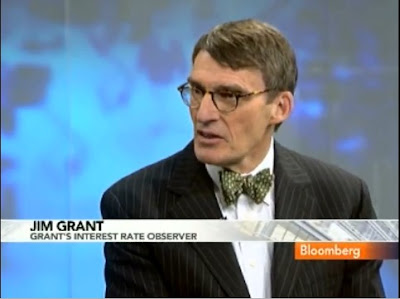
If you read James Grant's excellent and succinct piece on banking reform, you might also be interested to see his latest appearance on Bloomberg TV.
Grant recently joined Pimm Foxx on "Taking Stock", where he discussed the economic recovery, the problems of our 21st century 'capitalism', and how to implement truly meaningful banking reform.
I was surprised and delighted to hear Jim bring up Brown Brothers Harriman as an example of a long-lived investment banking firm that had survived this crisis due its prudence and its more conservative partnership structure, in which owners are personally accountable for losses.
In recent weeks, I had been half-jokingly mulling over this very example of a private bank which stuck to its roots and sailed through the crisis unimpeded. Great to hear Grant bring up this point and elaborate on it so nicely; be sure to listen for it.
Monday, April 26, 2010
Best reform? Let bankers fail
James Grant penned a great opinion piece on banking reform for the Washington Post called, "The best financial reform? Let bankers fail".
Here's an excerpt from Jim's essay:
"The trouble with Wall Street isn't that too many bankers get rich in the booms. The trouble, rather, is that too few get poor -- really, suitably poor -- in the busts. To the titans of finance go the upside. To we, the people, nowadays, goes the downside. How much better it would be if the bankers took the losses just as they do the profits.
Happily, there's a ready-made and time-tested solution. Let the senior financiers keep their salaries and bonuses, and let them do with their banks what they will. If, however, their bank fails, let the bankers themselves fail. Let the value of their houses, cars, yachts, paintings, etc. be assigned to the firm's creditors..."
You can see why I like it already. Be sure to read the whole thing if you haven't already, and pass it on to your friends and colleagues.
You might even want to send it on to some of the politicians in your state, some of whom are just dying to provide their own monstrous legislative "solutions" to problems they probably helped to create.
Related articles and posts:
1. James Grant on "Taking Stock" with Pimm Foxx - Bloomberg.
Here's an excerpt from Jim's essay:
"The trouble with Wall Street isn't that too many bankers get rich in the booms. The trouble, rather, is that too few get poor -- really, suitably poor -- in the busts. To the titans of finance go the upside. To we, the people, nowadays, goes the downside. How much better it would be if the bankers took the losses just as they do the profits.
Happily, there's a ready-made and time-tested solution. Let the senior financiers keep their salaries and bonuses, and let them do with their banks what they will. If, however, their bank fails, let the bankers themselves fail. Let the value of their houses, cars, yachts, paintings, etc. be assigned to the firm's creditors..."
You can see why I like it already. Be sure to read the whole thing if you haven't already, and pass it on to your friends and colleagues.
You might even want to send it on to some of the politicians in your state, some of whom are just dying to provide their own monstrous legislative "solutions" to problems they probably helped to create.
Related articles and posts:
1. James Grant on "Taking Stock" with Pimm Foxx - Bloomberg.
Monday, December 7, 2009
Jim Grant: requiem for the dollar
Over the weekend, I started reading what has to be the article of the week, and very possibly, one of the top choices for Article of the Year: Jim Grant's latest WSJ opinion piece, "Requiem for the Dollar".
Here's an excerpt from that piece:
"Ben S. Bernanke doesn't know how lucky he is. Tongue-lashings from Bernie Sanders, the populist senator from Vermont, are one thing. The hangman's noose is another. Section 19 of this country's founding monetary legislation, the Coinage Act of 1792, prescribed the death penalty for any official who fraudulently debased the people's money.
If you want a great, article-length review of our money system and how we got to where we are today, definitely check out Grant's essay in full.
PS, if you'd like to know more about the country's monetary laws, you may want to seek out Edwin Vieira's very thorough book, Pieces of Eight.
Related articles and posts:
1. Jim Grant on CNBC: get set for inflation - Finance Trends.
2. Rothbard: The Founding of the Federal Reserve - Finance Trends.
Here's an excerpt from that piece:
"Ben S. Bernanke doesn't know how lucky he is. Tongue-lashings from Bernie Sanders, the populist senator from Vermont, are one thing. The hangman's noose is another. Section 19 of this country's founding monetary legislation, the Coinage Act of 1792, prescribed the death penalty for any official who fraudulently debased the people's money.
Was the massive printing of dollar bills to lift Wall Street (and the rest of us, too) off the rocks last year a kind of fraud? If the U.S. Senate so determines, it may send Mr. Bernanke back home to Princeton. But not even Ron Paul, the Texas Republican sponsor of a bill to subject the Fed to periodic congressional audits, is calling for the Federal Reserve chairman's head.
I wonder, though, just how far we have really come in the past 200-odd years. To give modernity its due, the dollar has cut a swath in the world. There's no greater success story in the long history of money than the common greenback. Of no intrinsic value, collateralized by nothing, it passes from hand to trusting hand the world over. More than half of the $923 billion's worth of currency in circulation is in the possession of foreigners..."If you want a great, article-length review of our money system and how we got to where we are today, definitely check out Grant's essay in full.
PS, if you'd like to know more about the country's monetary laws, you may want to seek out Edwin Vieira's very thorough book, Pieces of Eight.
Related articles and posts:
1. Jim Grant on CNBC: get set for inflation - Finance Trends.
2. Rothbard: The Founding of the Federal Reserve - Finance Trends.
Wednesday, September 23, 2009
Fed talks up recovery, but is it real?
The Federal Reserve is highlighting signs of recovery as officials leave benchmark interest rates unchanged; The FOMC has voted 10-1 to keep the target fed-funds rates at 0% to 0.25%.
There's also talk that the Fed will wind down its enormous MBS and housing agency bond purchases, according to Bloomberg and the Wall Street Journal. The FOMC will extend their program out to 2010 while slowing the pace of purchases in order to provide a "smooth transition" to the markets.
So we started the week off with a debate over Jim Grant's call for a snappy recovery, and now we have some more economic happy talk from the Fed. Despite tent cities cropping up all over the United States, the stock market (and long participants) seems happy. And why not?
From Bloomberg, "Stocks Extend Gains...":
"Equities have surged since March as the Group of 20 nations committed about $12 trillion to revive economic growth and the Fed kept overnight borrowing costs near zero to unlock credit markets.
There's also talk that the Fed will wind down its enormous MBS and housing agency bond purchases, according to Bloomberg and the Wall Street Journal. The FOMC will extend their program out to 2010 while slowing the pace of purchases in order to provide a "smooth transition" to the markets.
So we started the week off with a debate over Jim Grant's call for a snappy recovery, and now we have some more economic happy talk from the Fed. Despite tent cities cropping up all over the United States, the stock market (and long participants) seems happy. And why not?
From Bloomberg, "Stocks Extend Gains...":
"Equities have surged since March as the Group of 20 nations committed about $12 trillion to revive economic growth and the Fed kept overnight borrowing costs near zero to unlock credit markets.
The 58 percent rally in the S&P 500 since March 9 has left the gauge trading at about 20 times its companies’ reported profits from continuing operations, the highest level since 2004, according to data compiled by Bloomberg."
$12 trillion. That's the amount of money that has been thrown at this crisis. For now, the unprecedented liquidity infusion seems to be doing its work, keeping asset prices aloft. We may even continue to see higher stock prices here in the US for a time, but have we really left this crisis behind?
Related articles and posts:
1. Marc Faber: "Nothing has been solved" - Tech Ticker.
2. The Pinocchio Recovery - Market Talk.
Monday, September 21, 2009
James Grant on the "V-shaped" recovery
One of the most talked about economic stories of the weekend was Jim Grant's piece in the Wall Street Journal, "From Bear to Bull".
In it, Grant discusses the rationale for a rather zippy (or "V-shaped") recovery following this steep recession that began (officially) in late 2007. Here are some excerpts from that piece:
"The Great Recession destroyed confidence as much as it did jobs and wealth. Here was a slump out of central casting. From the peak, inflation-adjusted gross domestic product has fallen by 3.9%. The meek and mild downturns of 1990-91 and 2001 (each, coincidentally, just eight months long, hardly worth the bother), brought losses to the real GDP of just 1.4% and 0.3%, respectively...
In it, Grant discusses the rationale for a rather zippy (or "V-shaped") recovery following this steep recession that began (officially) in late 2007. Here are some excerpts from that piece:
"The Great Recession destroyed confidence as much as it did jobs and wealth. Here was a slump out of central casting. From the peak, inflation-adjusted gross domestic product has fallen by 3.9%. The meek and mild downturns of 1990-91 and 2001 (each, coincidentally, just eight months long, hardly worth the bother), brought losses to the real GDP of just 1.4% and 0.3%, respectively...
...Americans are blessedly out of practice at bearing up under economic adversity. Individuals take their knocks, always, as do companies and communities. But it has been a generation since a business cycle downturn exacted the collective pain that this one has done.
Knocked for a loop, we forget a truism. With regard to the recession that precedes the recovery, worse is subsequently better. The deeper the slump, the zippier the recovery. To quote a dissenter from the forecasting consensus, Michael T. Darda, chief economist of MKM Partners, Greenwich, Conn.: "[T]he most important determinant of the strength of an economy recovery is the depth of the downturn that preceded it. There are no exceptions to this rule, including the 1929-1939 period."
If you'd like to read more, see the full piece at the link above.
Related articles and posts:
1. Jim Grant on CNBC: get set for inflation - Finance Trends
2. James Grant on Bloomberg TV - Finance Trends
3. "Jim Grant: Ringing the Bell at the Top?" - Financial Armageddon.
4. The Aftermath of Financial Crises - NBER.
Thursday, June 25, 2009
Eric King interviews Rick Rule
Eric King serves up another great interview for us at King World News Broadcast, this time with investor Rick Rule, of Global Resource Investments.
It's been a while since we've heard from Rick here at Finance Trends, but as long-time readers and Rick Rule fans will know, his views on everything, from investing in the natural resource markets to free-market economics and libertarian philosophy, are always insightful and often fascinating.
Enjoy the interview with Rick Rule, and check out more of King's interviews with guests such as Marc Faber, Barry Ritholtz, and Jim Grant at the King World Broadcast page (Hat tip: Controlled Greed).
Related articles and posts:
1. Rick Rule: The Golden Rule - Finance Trends.
2. Three rules for buying resource stocks - Finance Trends.
It's been a while since we've heard from Rick here at Finance Trends, but as long-time readers and Rick Rule fans will know, his views on everything, from investing in the natural resource markets to free-market economics and libertarian philosophy, are always insightful and often fascinating.
Enjoy the interview with Rick Rule, and check out more of King's interviews with guests such as Marc Faber, Barry Ritholtz, and Jim Grant at the King World Broadcast page (Hat tip: Controlled Greed).
Related articles and posts:
1. Rick Rule: The Golden Rule - Finance Trends.
2. Three rules for buying resource stocks - Finance Trends.
Thursday, June 11, 2009
Jim Grant on CNBC: get set for inflation
Jim Grant joined CNBC for an in-studio appearance Wednesday and left the network bubbleheads with a few things to think about.
Big topic of discussion: inflation and its appearance in the US following the recent raft of money creation by central banks, the Fed in particular.
Grant notes that many in the US believe that inflation will not flare up due to "excess capacity" in the economy. However, Jim points out that measures of "output gaps" in the economy are not a useful leading indicator of inflation, and he reminds the assembled crowd that inflation is simply a product of "too much money".
At some point, that money will begin to chase something, be it consumer goods, services, commodities, and those price rises will signal the arrival of inflation as measured by CPI.
Always good to hear some thoughts from James Grant, especially since his equally thoughtful contemporaries, Marc Faber and Jim Rogers, have been notably absent from CNBC America lately (probably due to their rather dour outlook on the US).
Hat tip to Todd Sullivan at Value Plays.
Related articles and posts:
1. James Grant on Bloomberg TV - Finance Trends.
2. Federal Reserve audit support surging - Huffington Post.
Subscribe to:
Posts (Atom)