Showing posts with label Bonds. Show all posts

Tuesday, April 30, 2013

Bonds vs. stocks, March 2009 - April 2013

Shared this relative performance chart of bonds vs. equities on StockTwits this morning, and wanted to post it here for our readers.

Here is TLT (US Treasury bonds) vs. the returns of QQQ (Nasdaq 100 ETF) and SPY (S&P 500 ETF), from March 13, 2009 to April 30, 2013. 


As you can see from the chart above, TLT has gained about 20 percent (not including dividends) in this 4 year period. QQQ is up 144 percent and SPY is up 110 percent from the start of this recent bull market in equities. 

In terms of price (directional) correlation, you'll note that while the QQQ and SPY are very closely linked, the two stock index ETFs seem negatively correlated with TLT. When stocks are up, government bonds are lagging and vice versa, at least for the period in question.

Monday, February 6, 2012

Puplava: listen to what the markets are saying

While catching up with Chris Puplava's latest market update last night, I had to stop and share some of his words with our followers on Twitter. 

Read the opening of Chris' article, "Stop Talking and Start Listening!". You'll find some worthwhile comments on interpreting data and the importance of maintaining accountability in one's market calls. 

"...Far too often investment managers and economists spend more time espousing their views and then defending them until eventually proven right (“I was just early”), rather than spending more time analyzing their assumptions and being honest enough to say, “I WAS WRONG!” and then moving forward. 

Part of the problem is that they create a view and then find evidence to support their views rather than starting from the bottom up by collecting an exhaustive amount of data and then summarizing the collective message rather than their views. 

Basically, listen to the message of the markets and then interpret those messages rather than telling the markets what they should be doing. What the market IS doing is far more important than what you think the market SHOULD be doing..." 

This is an excellent summary of one of the biggest problems I see in the 24/7 cycle of market commentary and trading. People have become too enamored of their own market view/"thesis" and too concerned about the risk to their reputations to come out and admit they're wrong.

Of course, if you are tied to a certain view or position and can't admit you are wrong, it could have an adverse effect on your trading or investing returns. Some people may hesitate to cut their losses on a bad trade or reverse their position (say, by going from short to long on a certain security or asset) if they've anchored themselves to a privately held or publicly expressed view.

Now that blogs and real-time social networks have allowed us all to become "mini-pundits", the risk of spouting off in public and ignoring the message of the markets has shifted down from media stars and big-name fund managers to the rest of us. 

But guess what? That also provides us with an opportunity to face the music and occasionally admit we were wrong about something, which may actually help build trust with our audience (and in ourselves) in the long-term. 

Because let's face it: no one wants to listen to someone who is never wrong and is always (magically) right. Why? Simple. Such people don't exist, oracles and sages of mythology aside.

Now back to the macro view. Despite some well-known recent calls for recession from ECRI and others, Puplava feels the markets and economy are in "bullish harmony" and are sending us a message that there is no bear market or recession ahead. Take a look at the article and examine the arguments for yourself. 

And remember, hold yourself accountable for your own market actions and judgements. Try not to impose your views on the market, and try to be flexible in your trading, especially when it comes to admitting you are wrong about something. Your thinking and your results might improve!

Related articles and posts: 

1. Zen and the Art of Trading.

2. What makes a great trader? Managing risk.

Thursday, December 8, 2011

Kyle Bass on sovereign debt crisis and gold


Hayman Capital's Kyle Bass discusses the world economy, gold, global credit growth, and debt problems in US, Japan, and Europe at the AmeriCatalyst 2011 conference. 

Here's the, "Black Swan of Cairo" piece (Nassim Taleb and M. Blyth) cited by Bass.

Hat tip: Olivier at Tischendorf Letter for highlighting this clip and the article.

And if you missed it, here's Kyle's interview on BBC Hardtalk, skillfully dodging TV sensationalism and speculator-scapegoating attacks to address the euro crisis, the developed world's sovereign debt troubles, and how he is managing risk in his portfolio and hedging against problems in Japan. 

Quoth Bass: "Capitalism without bankruptcy is like Christianity without hell". 

In other words, the Western world must atone for its past financial profligacy. Check it out.

Thursday, October 27, 2011

Around the world in 8 charts

The charts tell the tale of the October rally. 

Since our last update on the global correction in stocks, shares have bottomed (at least in the short-term) and embarked on a powerful new rally. 

As noted in real-time on Twitter and StockTwits, the 1,250-1,260 levels were an important technical (and psychological?) level for the S&P 500 and US shares. The market busted through those levels this week amid a backdrop of hectic news concerning Europe's debt crisis. 

Here you'll find newly updated charts, from the SPX to the AWCI (MSCI World ETF), the Dow Industrials and Transports, the Nasdaq, the EEM (Emerging Markets ETF), the VIX, and TLT (long-bond ETF). 


This is still a very news-driven (some would say intervention-driven) market. Therefore, I want to either watch (or ignore) the action from the sidelines or keep a very tight reign on positions and risk. We'll see if the global share markets can continue higher on a stream of bad news, a sign of a potential bullish uptrend in the making.

Keep up with Finance Trends in real-time on Twitter and StockTwits. You can follow our RSS feed (full posts, always free) to catch all our posts.

Wednesday, October 5, 2011

Jeffrey Gundlach interview: deflation risk


Noted bond fund manager and DoubleLine founder, Jeffrey Gundlach speaks with FT.com about the economy, deflation risks, and his views on Treasury bonds. 

Some highlights from this interview:

  • DoubleLine notes that the market has been affected by shifts in sentiment relating to potential inflationary outcomes vs. deflationary outcomes. Gundlach seeks to take advantage of pendulum shifts in sentiment by positioning his portfolio more into government bonds when everyone is focused on inflation, bucking the prevailing sentiment trends. 
  • As unattractive as Treasury yields appear to be from a historical standpoint, investment managers should own bonds "even today" as a hedge.
  • "I used to be an inflationist several years ago". Gundlach understands the printing-money-to-cover-entitlements view, but feels that this pro-inflation scenario is unlikely to happen without a crisis. Gundlach feels you will first see economic weakness and a societal trend towards reigning in deficit spending. Hence, deflationary arguments are at the forefront.
  • Tremendous income polarization in the United States. This has often led to societal unrest. Hard times for working class vs. plush times for multinational corporations will lead to calls for increased corporate taxes. Expect lower PEs for stocks in that environment.
Catch the full take at the link above.

Wednesday, September 21, 2011

Long bonds flying on Operation Twist - $ZB_F $TLT

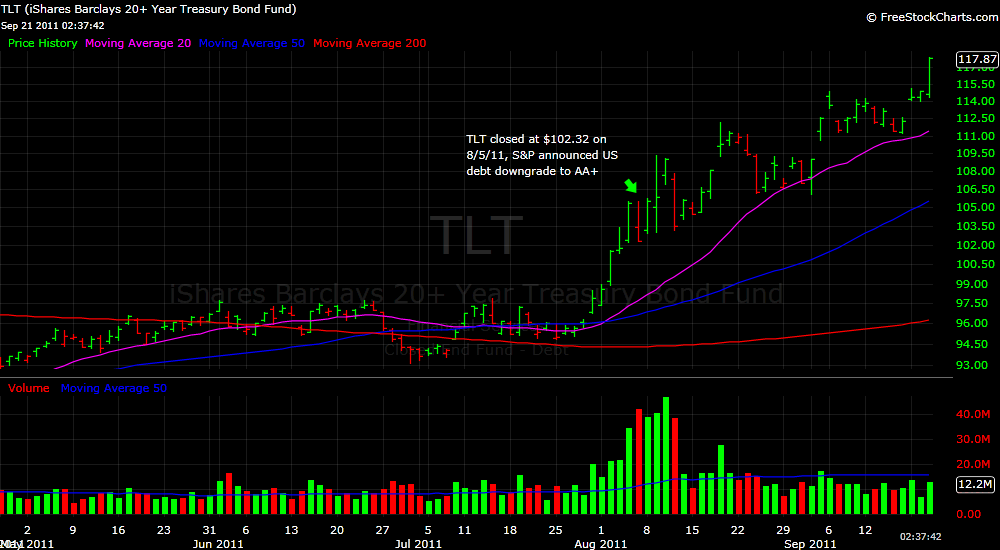
Earlier this afternoon on Twitter, I noted that the long bond ETF, TLT was up over 10% (then quoted near $114.60) since S&P downgraded the USA's debt rating to AA+ on August 5, 2011.

Well, it looks like we'll have to update those stats already, thanks to the pop in 30 year bonds (ZB_F) and in TLT on news of Operation Twist, the Fed's telegraphed scheme to sell $400bn of short maturity bonds and reinvest in longer (6 to 30 year) bonds by June 2012. 

Here's how the market reacted to that news. Note the flagpole move up in TLT and the 30 year Treasury futures, ZB_F on the intraday charts. 


 Above: 5 minute chart of the 30 year Treasury futures, via Finviz.com.


Here's an intraday chart of TLT, courtesy of freestockcharts.com.


The updated daily chart of the TLT, marking the August 5th closing price to today's action on the Twist announcement. Chart via freestockchats.com.

So in the space of 20 minutes, we had to recalculate that 6 week return figure (post S&P debt downgrade): the long bond ETF TLT is now up 13% since its close on August 5th, based on an intraday price of $117.70

What a difference a day makes...

Thursday, August 4, 2011

Sitting on the sidelines, reading

"The worst thing you can do when you're having a hard time is flail. In trading, when there is nothing to do, the best thing to do is nothing." - Scott Bessent (Bessent Capital). 

Well, the damage is already done for those who were heavily long heading into this week's market decline. 

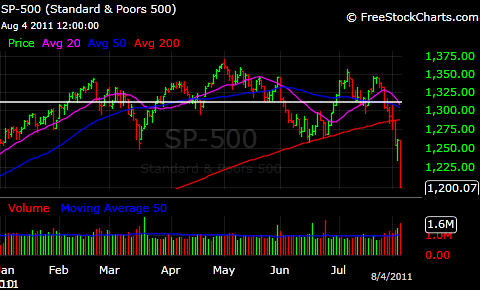
I look at the S&P 500 component data on freestockcharts.com and see that only 3 stocks in that index were up today. We saw a -4.78% decline in the S&P to go along with that. Here's an updated chart that shows the recent breakdown below the 1312 line we've fluctuated around in recent months.


There's been a lot of whipsaw in this news driven market of late, and it doesn't seem like the recent deficit/debt ceiling deal reached by Congress has quieted things much. Even gold and silver got whacked today. But just look at all that money piling into Treasury bonds.


At a time like this, perhaps it's best to step aside and watch the action from the sidelines. That may not be the proper stance for a short-term trader making hay from all this volatility, or a professional money manager tasked with managing positions on the long and short side, but for now it suits me fine. 

In July, I closed out a couple of losing stock trades and haven't put on any new trades since. I've mostly been pruning watchlists, reviewing my trading journals and trading mistakes, running through charts, and reading. A break from trading was needed, and this was the time to do it.

Today, while reading Steven Drobny's Inside the House of Money, I came across our intro quote in an interview with "stock operator" and hedge fund manager, Scott Bessent. On a day like today, you can really appreciate the time honored truths that: 1) being in cash is a position, and, 2) activity (trading) for the sake of activity can be a real hazard to your trading account and your emotional capital. 

By the way, the interview with Bessent is a great chapter from Drobny's book. Here is a guy who, amazingly, has worked for or trained under George Soros, Stan Druckenmiller, Nick Roditi, Jim Rogers, and Jim Chanos. It's quite something to not only read Bessent's thoughts on trading, but to hear what he's learned from some true all-stars of the hedge fund world. Check out this book if you're taking a late-summer break and keeping your powder dry as well.       

Monday, July 18, 2011

US debt crisis is contrived, says Jim Grant


The US debt crisis is a contrived political showdown, James Grant tells Bloomberg TV. If you want a real crisis, look to Europe, says Grant. 

Also up for discussion: the 30 year bull market in US Treasuries and the risks associated with government paper. Plus, the future of monetary arrangements and the gold standard vs. the "Phd standard". Enjoy the clip.

Wednesday, April 20, 2011

Wealthtrack interview with James Grant


Grant's Interest Rate Observer founder, Jim Grant sits down with Consuelo Mack for an interview on WealthTrack.

Topics include: the rising cost of living and commodities, the US dollar's decline, and the Federal Reserve's targets for "desired inflation". See what Grant has to say about all this, and more, in this discussion.

By the way, I don't think anyone who caught Grant's interview or Michael Burry's recent talk on America's financial condition was surprised by S&P's recent warning on America's AAA debt rating. Only the timing of the outlook revision might have come as a surprise, and even that may have been telegraphed to market participants earlier.

Related articles and posts:

1. Jim Grant and John Hathaway chat with Charlie Rose.

2. Jim Grant's latest interview with King World News.

3. Lew Rockwell and Jim Grant discuss Austrian economics, gold standard.

Wednesday, January 26, 2011

Marc Faber on Davos, "dishonest" Obama (Bloomberg TV)


Newsy: Marc Faber talks to Bloomberg TV about Davos, the disastrous 1st term of our dishonest President Obama, the illusion of deficit spending prosperity, and more.

If you're a regular here, you already know how much we love the straight-shooting Dr. Faber. This latest chat is one more example of Faber's natural ability to cut through the propaganda and nonsense and get straight to the heart of matters.

Have a listen and catch Marc's latest thoughts on the US and emerging markets, the "global agenda setters" of Davos, bonds, inflation, and gold. Enjoy.

Related articles and posts:


1. Marc Faber: final crisis yet to come - Finance Trends.


2. Jim Rogers at Reuters 2011 Outlook Summit - Finance Trends.

Friday, January 14, 2011

They'll just change the rules

Inflation or deflation ahead?

Why, after the bursting of a massive credit bubble, do losses from defaulted debt go unrecognized? How is that we simply continue to hum right along?

Chris Martenson explains in, "Don't worry, they'll just change the rules":

"Suppose, for the sake of argument, that there is a world in which banks are allowed by their regulators to pretend their default losses simply do not exist. And, even more outlandishly, some of these banks are allowed to sell heavily damaged loans to their central bank at nearly their full original price.

What does "deflation" mean in such a world? Not much, as it turns out. At least from a monetary perspective, because money is not being destroyed at nearly the rate that would be expected or predicted by the size and rate of the defaults.

This is the world in which we currently live. Trillions in probable and provable losses quietly exist, out of sight, on the balance sheets of the Federal Reserve and other financial institutions. If they ever come out of hiding and onto the books, I think the deflationists will be proven correct beyond all doubt..."

Which brings Martenson to his next point: the "extend and pretend" game which favors the "too big to fail" (TBTF) banks is part and parcel of the trend towards changing the rules of the game at will. In this framework, what should happen may not transpire at all, or at least not for some time.

"...The theme here is simple enough: If and whenever the circumstances justify a major response, existing rules will be changed, altered, bent, or broken.

Because of this, I routinely argue that what should happen won't happen, at least not right away, and that there's really no such thing as investing anymore, only speculating -- unless you are a big bank, favored by the Fed, with advance information..."

Check out the full piece to hear why the rules of the game are constantly changing, and why we're all speculators (as opposed to investors) now.

Wednesday, October 6, 2010

CNBC chats w/ Kyle Bass, Alan Fournier

CNBC took their porta-studio down to Texas to chat with Kyle Bass (Hayman Capital) and Alan Fournier (Pennant Capital) at the Barefoot Economic Summit earlier today.

Since I got a heads up on this interview from some folks in my Twitter stream, I thought I'd track down the interview clips from CNBC and post them here for all to see.

Kyle Bass is well known for his big picture macro views, and he's made some pointed remarks recently about the path the US is heading down given the Fed's quantitative easing efforts. You'll hear Bass compare the monetary situation in the US with the hyperinflationary episode of Weimar Germany, and the more recent case of Zimbabwe, in this discussion.

This interview also offers him a chance to elaborate a bit on his recent call to avoid stocks (in general) and instead look to real assets, such as commodities and gold, in an inflationary environment. Enjoy the discussion and the insights from Bass and Fournier in this 3 part interview.

CNBC talks with Kyle Bass & Alan Fournier at the Barefoot Economic Summit: Part 1, Part 2, Part 3.


Thursday, August 26, 2010

War on savings continues: bank fees and zero rates

Bank fees and ultra low interest rates continue to hit US savers hard. Bloomberg has the story in, "Savers Pay Banks to Keep Cash as Rates Dip, Fees Rise":

"It’s getting tougher for U.S. savers to find a bank where they won’t end up paying to keep their money safe.

The average interest paid on savings, checking, money-market and certificate of deposit accounts fell to 0.99 percent in July, the first dip below 1 percent in a decade, according to researcher Market Rates Insight. Banks also have been raising fees and adding new ones, most recently in response to the financial-services overhaul bill that became law July 21.

The result is that an increasing number of savers are seeing their deposit earnings eaten up by charges. That’s frustrating people like Ken Ward, who recently passed on a savings account with a 0.01 percent interest rate at the Chase bank branch near his home in Wantagh, New York..."

As if years of hyper-spending and living beyond our means consumption haven't hurt the average American family's balance sheet enough, we continue to struggle through a period in which near zero rates and real world inflation take their toll on savers.

Here's an interesting (and depressing) little fact from Tradefast: "if you need/want $100,000 of income in retirement, you only need to buy $26.7 million of US Treasury 2 year notes to reach your goal".

Of course, if you go out 10 years at 2.51% (current yield on 10 year US Treasury), you'll probably only need about $4 million worth of Treasury bonds to reach the same income goal.

It's interesting to note that many retail investors seem to have abandoned the stock market over the past 30 months, taking $209 billion out of domestic stock funds while $559 billion flowed into bond funds during that time. If these ultra low rates can't spur investors into the stock market, it seems that nothing (short of an incredible, longer-term rally) can.

One of the big investing themes in recent months has been the search for yield, as US savers and investors reach to grab any interest income that they can. Meanwhile, as mainstream news outlets tout vehicles such as junk bond funds and ETFs to yield starved investors, onlookers such as John Rubino warn this trend will only end badly for savers and investors.

Low to negative real interest rates continue to greet savers and investors; it seems the war on thrift and savings continues unabated.

Related articles and posts:

1. The Low-Interest Rate Trap - Dollar Collapse.

2. Investors Shake Up Funds w/ Record Bond Love Affair - Bloomberg.

Wednesday, August 11, 2010

Layperson's guide to the Federal Reserve

Kevin Depew at Minyanville has authored, "The Real Person's Guide to the Federal Reserve", which should help set the record straight on what exactly was said in the most recent Fed release.

Here's an excerpt from Kevin's guide:

"Yesterday at 2:15 PM EST the
Federal Reserve released what to most of us normal people was a bunch of gibberish, including this:

"To help support the economic recovery in a context of price stability, the Committee will keep constant the Federal Reserve's holdings of securities at their current level by reinvesting principal payments from agency debt and agency mortgage-backed securities in longer-term Treasury securities."

In the aftermath of the financial crisis, most of us are now at least vaguely aware that the Federal Reserve has intervened in financial markets to "help support the economic recovery." But what, exactly does that mean, intervention? It's actually not that hard to understand, not as hard as you might think..."

Dig the explanation on the Fed's purchases of mortgage-backed securities and why these asset purchases are said to be closely linked with the stability of the financial system at the link above.

You might also want to check out this handy graph of "Credit Easing Policy Tools" from the Cleveland Fed's website (Hat tip: Prudent Investor).

Related articles and posts:

1. Caroline Baum: Economy lost momentum while I was pulling weeds - Bloomberg.

Monday, June 14, 2010

Seth Klarman profiled in Bloomberg

Hedge fund manager and author, Seth Klarman (Baupost Group) was recently profiled in Bloomberg for his investing acumen, as well as for the enduring popularity of his 1991 book, Margin of Safety.

An excerpt from, "Klarman Tops Griffin as Investors Hunt for 'Margin of Safety'":

"
Seth Klarman almost doubled his hedge fund’s assets to $22 billion in the past two years as the industry shrank by sticking with the off-the-beaten-path investments he’s pursued since starting out in 1983.

Unlike John Paulson, who made $15 billion by betting against home mortgages, Klarman didn’t see one big trade that would profit as markets began to collapse. The founder of Baupost Group LLC focused on corporate bonds he calculated would yield solid returns even if the economy got worse.

“We didn’t have the degree of conviction Paulson had,” said Klarman, whose views are so closely watched by investors that his out-of-print book, “The Margin of Safety,” is offered on Amazon.com for more than $1,700. “We don’t deal in absolutes. We deal in probabilities,” he said in an interview at his Boston office..."

Check out the full piece above for more on Klarman's super-impressive investment returns (risk considered) and investing philosophy.

You can also find more about Klarman and his book, Margin of Safety, in our related posts section.

Related articles and posts:

1. Seth Klarman: Margin of Safety - Finance Trends.

2. Margin of Safety: reader notes - Finance Trends.

3. Seth Klarman: Lessons from 2008 - Value Plays via Finance Trends.

4. Seth Klarman resource page - Value Stock Plus.

Friday, May 28, 2010

Niall Ferguson on Fiscal Crises and Imperial Collapse


Niall Ferguson recently spoke on "Fiscal Crises and Imperial Collapses" at the Peterson Institute for International Economics.

The event summary, presentation transcript and slides, as well as audio and video of the talk and Q&A session, are all available at the PIIE link above.

I happened to watch Niall's historical overview of government debt crises last night, and it certainly put the current problems we are facing with sovereign debt into perspective. On a day when we are greeted with news of Spain losing its AAA rating through a Fitch downgrade, Niall's speech certainly comes at a pressing moment and the lessons he imparts are profound.

Listen closely to Ferguson's conclusion on the historical impact of the bond vigilantes in each public debt crisis. Each time, he points out, interest rates on government debt skyrocketed when bond holders saw an unsustainable fiscal program threaten the viability of a nation's debt repayment and market participants delivered their verdict by driving up interest rates on public debt.

The current crisis period is no different, despite the ravings of politicians who go on about evil speculators "attacking" their poor country's debt. As Ferguson shows, there is a time honored manner "in which financial markets voted on the credibility of a government’s fiscal policy", and the striking feature of public debt crises is the sudden loss of confidence that might befall any nation's public debt.

Enjoy the video and the insights offered in Ferguson's timely historical analysis.

Wednesday, May 12, 2010

Der Spiegel interview with Nouriel Roubini

Spiegel Online interviews economist Nouriel Roubini, who notes, "We will have even more crises in the future".

An excerpt from Nouriel on problems in Europe and government debt:

"
SPIEGEL: What do you think about the dangers presented by Greece?*

Roubini: Today the markets are very worried about Greece, but that's only the tip of the iceberg. Increasingly, bond market vigilantes have woken up in places like the UK and Ireland. Even the US and Japan will have problems because of their huge budget deficits. Maybe not this year, but they will eventually. In the US, states like California, Nevada, Arizona, New York and Florida have immense fiscal problems. The growing budget deficits and the huge government debts are really what worry me most.

SPIEGEL: Is it really the right thing to do for the IMF and the EU to help out Greece with €110 billion?

Roubini: That is only kicking the can down the road for a year. I am afraid that Greece, more likely than not ,isn't just illiquid, but insolvent. And providing an insolvent country with money and forcing it to make painful cuts isn't going to do it. Even if taxes are raised and spending is cut, Greece won't necessarily become more competitive. On the contrary, output might fall, unemployment might rise and market share will be lost. We need a plan B."

To hear more about plan B and Roubini's outlook on the world's economies, check out the full piece at the link above.

We'll have more on the problems in Europe and the Western economies (US, UK, et al.) tomorrow, so be sure to tune in with us then.

Thursday, April 8, 2010

Michael Burry explains subprime CDS trade

Michael Burry explains credit default swaps and his subprime short to Scion Capital investors in this November 2006 document shared by Marketfolly:

"A big hat tip to
Greenbackd for originally bringing this to our attention. Below you will find a very interesting primer on credit default swaps and the subprime mortgage short from Scion Capital's hedge fund manager Michael Burry.

Burry of course was recently featured in Michael Lewis' latest book,
The Big Short (which we highly recommend reading) for his notable early short position in subprime mortgages.

Michael Burry penned his primer back on November 7th, 2006 and it's almost comical now to think about how he was running a value fund focused on equities and then all of a sudden has to explain his short subprime trade and complex derivatives to his certainly surprised and confused investors..."

Head on over there to read the full embedded document. Should make for very interesting reading, as by now I've read and heard several accounts of how difficult it was for Burry to hold on to his famous trade in the face of overwhelming resistance from his investors.

While you're at it, you can also check out Michael Burry's recent op-ed in the NY Times deflating the great Greenspan myth that "no one saw the crisis coming". Essential reading for those who believe the endless barrage of lies coming from the econo-political "elites".

Related articles and posts:

1. FSN interview: Richard Eckert (Lahde Capital) - Finance Trends.

2. Michael Lewis on Charlie Rose: The Big Short - Finance Trends.

Wednesday, March 31, 2010

Interview: Russell Napier on global debt crisis

Financial Sense Newshour recently spoke to Ron Greiss of the Chart Store and Russell Napier of CLSA about the US and global debt pictures. You can hear what they have to say in this March 27 interview broadcast.

Soundbites from Alan Greenspan conceding that rising yields on US bonds are the proverbial canary in the coalmine for higher interest rates ahead lead off the broadcast. Jim Puplava and guest Ron Greiss have more to share on the state of the US' finances and its debt picture (which are rather grim).

Russell Napier chats with Jim later in this segment, sharing some key thoughts on the "structurally mispriced" US bond market. Anyone watching the Treasury market and the long-term direction of interest rates should check these interviews out.

Related articles and posts:


1. Russell Napier: The Next Crash - Finance Trends.

2. Anatomy of the Bear: Russell Napier interview - Financial Sense.

Friday, March 26, 2010

Economist on Greece bailout, er, "rescue"

The bailout structure you've all been waiting for is here, now that 16 nations of the European Union (EU) have agreed to supply Greece with a backstop for its debt financing problems.

The Economist has the details:

"“THIS was the case that was never supposed to happen,” said Angela Merkel on Friday March 26th, at the end of a short but tense European Union summit in Brussels. Germany’s chancellor did not need to elaborate. To her visible distaste, Europe’s leaders had just agreed a mechanism for rescuing Greece from a sovereign credit crunch...

...The mechanism agreed late on March 25th by the 16 countries that share the euro was harsh. At the insistence of Mrs Merkel, Greece will be able to tap into emergency help only if available market financing has been deemed “insufficient” by experts from the European Commission and European Central Bank..."

I'll be perfectly honest here and admit that I do not fully understand the ins and outs of this agreement, or how and when the rescue terms will exactly kick in (should Greece need to tap into the "emergency help").

Luckily for all of us, we get a simple background on Greece's problems and the EU-IMF rescue agreement from the Economist. It just might take more careful reading on your editor's part to get it through his addled brain.

You may also want to check out Peter Cohan's take on the Greek rescue plan and the EU debt contagion that's hitting Greece, Portugal, and Spain. I know I will want to avail myself of that knowledge before the weekend is through. Cheers!