Sunday, February 14, 2010

Video: Russia Forum 2010


Must watch video of a panel discussion with Marc Faber, Hugh Hendry, Nassim Taleb, Michael Power, and others at
The Russia Forum 2010.

As moderator, Marc Faber begins the discussion by asking the panel members how they would invest $100 million for the year ahead. A varied discussion on the global economy, geopolitics, inflation vs. deflation, risk, food and energy systems, and the rise of emerging markets ensues.

Great macro discussion with seeds of investing ideas and global macro trades sprinkled throughout. Don't miss this one, and thanks to Jay at Marketfolly for highlighting this discussion.

Friday, February 12, 2010

How far will Greece's problems spread?

So just to follow up on our last post about debt problems in Greece and the EU, I'm hearing that some people are having a hard time making sense of this crisis and what it means for the whole of Europe.

To that end, I've decided to highlight a few helpful articles that will further our understanding of these sovereign risk issues.

We're seeing a growing worry that problems in Greece, UK, Spain, et. al, will spread throughout the eurozone and signal problems for other developed nations as well. Are these fears justified? Let's take a quick look and see what we find.

First off, The Economist reported yesterday that the EU summit on Greece yielded only "vague promises of solidarity" and no concrete plans for how a bailout of Greece by larger EU nations might come about.

Here's an opening excerpt from that piece:

"“PRETTY catastrophic”. That was the verdict of a depressed-looking diplomat, at the end of a Brussels summit on Thursday February 11th that saw European Union leaders issue a ringing, but alarmingly vague, pledge of “determined and co-ordinated action” to preserve the euro zone from the risk of a Greek sovereign default.

The vagueness of the bail-out promise was no mystery. After years of footing the bills for successive Euro-crises, Germany is in a truculent mood. Of the 16 countries that share the single currency, most came to Brussels ready to spell out, in some detail, how they might come to the aid of Greece, without breaching “no bail-out” rules that prevent the EU from assuming the debts of countries in the euro zone."
Would a bailout of Greece accomplish much? According to SocGen strategist, Albert Edwards, it would only serve to delay what he sees as the inevitable: a Eurozone breakup.
Meanwhile, Niall Ferguson writes in a recent FT piece that the "Greek crisis is coming to America". He argues, as we (and others) have, that the US seems to be taking false comfort in its temporary "safe haven" status, when in fact it should be looking at the longer-term effects of its own debt explosion.
"For the world’s biggest economy, the US, the day of reckoning still seems reassuringly remote. The worse things get in the eurozone, the more the US dollar rallies as nervous investors park their cash in the “safe haven” of American government debt. This effect may persist for some months, just as the dollar and Treasuries rallied in the depths of the banking panic in late 2008.
Yet even a casual look at the fiscal position of the federal government (not to mention the states) makes a nonsense of the phrase “safe haven”. US government debt is a safe haven the way Pearl Harbor was a safe haven in 1941..."
So I think we have enough here to highlight the risks that investors and economic thinkers are currently mulling over. The question remains: will fiscal problems in places like Greece, Spain, and Dubai spread to established financial institutions and larger economies?

Wednesday, February 10, 2010

Understanding Greece and the EU

As I understand it, a bailout of any EU member nation (say Greece) is illegal under the Euro-establishing Maastricht treaty.

However, Josh Lipton at Minyanville points out a possible loophole should the European nations want to skirt that rule:

"The only real question for members of the Eurozone, says
Dr. Ed Yardeni of Yardeni Research, is whether to boot out or bail out the Greeks...

...The economist emphasizes that the Maastricht rules contains a "no bailout" clause to ensure that a member country's budgetary problems couldn’t spill over and damage the credit rating of the Eurozone as a whole.


However, he writes in a recent research note, there's belief that the Eurozone could get around this by invoking Article 122 of the Lisbon Treaty, which allows the European Union to throw a financial life-preserver to a member country suffering tough times."


So the next question for market watchers and EU citizens (or their political elites) to consider is whether or not the larger European nations should structure a bailout for Greece and other fiscally weak member states.

Actually, it's a question that's been tossed around for months as Mark Crosby notes in, "EU bailout no solution to Greece's problems". Take a look at this article to get an easily digestible overview of the problems facing Greece and the eurozone.

Monday, February 8, 2010

Bloomberg: weak dollar, inflation "illusory"

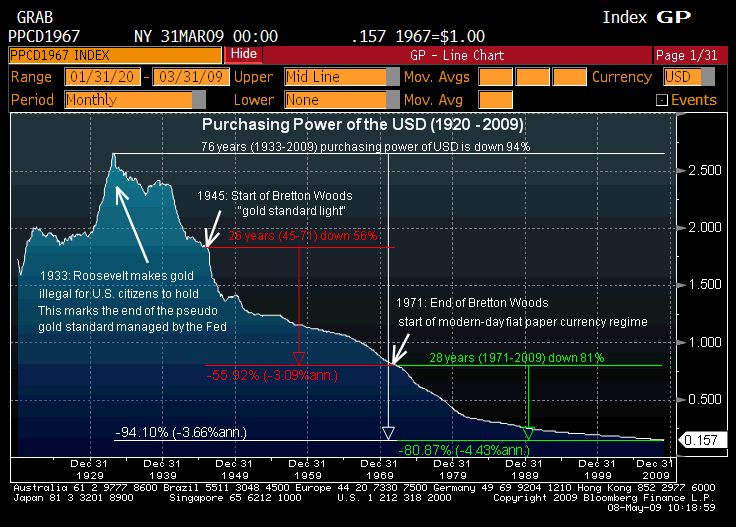
Apparently, the continued erosion of the US dollar's purchasing power and the ensuing inflation we've witnessed since 1975 has been merely an illusion.

So says Bloomberg in an astonishingly misleading article entitled, "Weak dollar illusory as correlated trade gains show"
:

"
For all the concern over the $1.6 trillion U.S. budget deficit and record debt load, the dollar is as valuable now as 35 years ago.
Measured against a basket of currencies from the Group of 10 nations proportioned by how they trade against each other, the greenback is up about 3 percent since 1975, according to Bloomberg Correlation-Weighted Currency Indexes.

That was four years after the Bretton Woods agreement, set up in 1944 to link currencies to the price of gold, collapsed. The U.K. pound has dropped 34 percent and the Canadian dollar has fallen 6 percent."

Using the Bloomberg Correlation-Weighted Currency Index as a value benchmark, the writer purports to show that the dollar is just "as valuable" now (more so!) as it was in the period just after Nixon "closed the gold window" and removed the last vestiges of the gold standard in 1971.

Here's an explanation of Bloomberg's weighted currency index:


"
The Bloomberg Correlation-Weighted Currency Indices (BCWI) provide an indication of the relative strength or weakness of one currency against the world, i.e., a representative basket of currencies."

The problem, of course, with assigning the dollar (or any fiat currency) a value based on the measure of a basket of currencies is that these currencies are all going down (gradually, over time) together. There is no consistent reference point for measuring true value.


This is how one editorialist, named Goldrunner, explained it:


"...We introduced how the Dollar Index can only be considered a fiat pricing scheme since it cannot reflect the value of the Dollar. Value can only be determined against a constant reference point- certainly not against a basket of items that are constantly changing."

This is particularly true during a time period when most currencies are being devalued like the time period we are now entering. This is because a group of currencies that are all falling in value, if priced against each other, will leave the currency falling the least looking as if it has risen. Down is then up.
"

You may be interested to see how the US dollar has fared against gold in recent years.

Chart courtesy of Bloomberg.com
While the index measurement shows the dollar to be holding steady (thanks to the "down is up" bias of said index) in the chart above, gold has still handily outperformed over a five year period. In fact, the precious metal, which started the period at a price of $411 an ounce has increased to over $1050 an ounce, a gain of over 150 percent.
Gold has increased over that period, not (as some would have you believe) because of a speculative "bubble", but because it's role as an international safe haven currency and a historical store of value (purchasing power) have been rediscovered by a new generation of investors.
There is far more to today's Bloomberg article than the dollar/gold relationship and confusion over the loss of our currency's purchasing power over time (see, for example Tim Geithner's eminently fadable opinion on the US government's AAA debt rating), but we'll have to address some of these themes in our next post (Update: see, "How far will Greece's problems spread?" for more on this).
In short, I've come to expect a bit more from Bloomberg than this. Hopefully, next time they will do their readers a real service by reporting the truth about our currency's gradual decline in purchasing power, sad as it may be. They might even look to their own data service & charts for help.

Thursday, February 4, 2010

Jim Chanos: "overheating" in China


Here's what I'm currently watching: noted short-seller and hedge fund manager, Jim Chanos gives a talk on "Overheating & Overindulgence" in China at the London School of Economics Alternative Investments Conference (see also: Bloomberg video).

We've noted here before that Chanos is hugely bearish on the Chinese economy and looking to bet against its overheated real estate and construction businesses by shorting commodities and ancillary suppliers.

In this presentation Chanos offers his thoughts on China's GDP growth, its credit excesses, and the interplay of its economic and political system. Very interesting stuff, even if Jim Rogers is skeptical over the recent findings of newly-minted China experts.

Is he right? Given my limited knowledge of the situation, I'm inclined to agree with Marc Faber (a friend of both Chanos and Rogers) who notes that Jim Chanos is "hyper smart" and willing to back his thesis, though it's uncertain how the timing of a Chinese bust will play out.

Related articles and posts:

1. Pivot Capital Report: China's Investment Boom - Finance Trends.

2. Is China Headed Towards Collapse? - Politico.

3. Marc Faber: China bubble bad for commodities - Tech Ticker.

Wednesday, February 3, 2010

Does real GDP growth signal recovery?

Over on Twitter this morning, The Kirk Report tweeted a link to a Wells Capital Management report that offers some upbeat news on prospects for economic recovery.

Here's an excerpt from that report entitled, "Current Real GDP Recovery Looks as Strong as 1975, 1982 Recoveries":

"Despite a strong fourth-quarter real GDP report, the debate surrounding the strength of the contemporary economic recovery lingers. Most seem to anticipate a subpar recovery similar to the last two during the early 1990s and after the dot-com meltdown in the early 2000s.

However, although the current recovery is only two quarters old, it is thus far closely tracking the strong recoveries of 1975 and 1982..."


There follows some interesting charts and data summaries which lead the authors to conclude that the current recovery, measured on real GDP growth, is much stronger than many had believed it would be.

I am happy to consider positive arguments for economic growth, but I'm also left to wonder how reliable these real GDP figures are, given the way we measure inflation statistics these days.

Tim Iacono at TMGM has a nice little chart that illustrates this relationship between real economic growth and inflation. Note how drastically the real GDP figures can change when inflation is overstated or understated.

For a more thorough discussion of why GDP figures are an unreliable and "heavily politicized" data point, please see this post on John Williams' Shadow Stats report on 4th quarter GDP.

Added notes: this blog post from the Daily Kos site offers an upbeat outlook on the GDP numbers and jobs recovery, similar to the Wells Capital report. What are your thoughts?

Monday, February 1, 2010

SIGTARP report: housing bubble 2.0?

Last night, FT came out with this report on Sig-TARP probing possible insider trading at US banks:

"
Neil Barofsky, the special inspector-general overseeing the US government’s financial rescue efforts, is to probe allegations of insider trading among bank executives and their associates.

Eight of the largest banks in the US received between $2bn and $25bn in October 2008 under a programme to prop up the financial system led by Hank Paulson, then Treasury secretary.

Dozens more institutions followed and Mr Barofsky, who examines the troubled asset relief programme, is looking into whether information improperly made its way to trading rooms during a feverish period in which the government and banks were frequently exchanging information..."

The article goes on to say that much of the latest SIG-TARP report focuses on government's increased role in the housing market.

"Much of Sig-Tarp’s new report is given over to an examination of the housing market and the multitude of government schemes designed to support lending and help homeowners avoid foreclosure.

“The government has done more than simply support the mortgage market,” the report said. “In many ways it has become the mortgage market with the taxpayer shouldering the risk that had once been borne by the private investor.”

Mr Barofsky added: “All of the things that were broken in the housing market and the different roles that different private players have played, some of what we recognise now . . . actually contributed to the bubble and to the ensuing crisis are really being replicated by government actors.”"

The myriad government bank lending programs have become too numerous and confusing for me. I imagine that it's very easy to lose track of all this information unless you are a writer, blogger, or news junkie particularly focused on the bank bailouts and lending programs designed to prop up US housing prices.

To catch up with some of these details, we might want to turn to Dr. Housing Bubble's blog for their new post on the "Stunning STIGTARP report" and "The Subtle Nationalization of the Banks and Housing Market". I can see some interesting data and insights leafing through this post, and will now give it a careful read.