Wednesday, April 29, 2009

Short view: Obama's first 100 days

FT.com's John Authers examines President Obama's first 100 days in office, and offers up an economic compare & contrast exercise with the first "first 100 days", those of FDR's 1932 term.

Related articles and posts:

1. FT in-depth: Obama's first 100 days - FT.com

2. Obama says he is 'remaking America' - Bloomberg.

Tuesday, April 28, 2009

Thomas E. Woods interview - Meltdown

Thomas E. Woods Jr., author of Meltdown: A Free-Market Look at Why the Stock Market Collapsed, the Economy Tanked, and Government Bailouts Will Make Things Worse, is rapidly becoming one of my favorite authors and economic historians.

Today we'll hear Tom's recent interview on the Financial Sense Newshour, in which he talks with host Jim Puplava about the true nature of our current economic crisis.

Tom Woods sees the crisis very differently from the media-driven consensus view of a panic fueled by "free market failures". Responding to calls for more government intervention to mend these supposed failures, Woods points out that the financial crisis is actually an outgrowth of past government interventions into the markets and economy.

Meltdown places particular emphasis on the artificially low interest rates and easy money policies created by the Federal Reserve under Alan Greenspan, and continued under current Fed chairman Ben Bernanke. Now as the crisis continues, the same people responsible for fostering the conditions that created this economic mess are somehow placed in charge of fixing the situation.

Hear Tom Woods and Jim Puplava discuss why the media slept through the buildup (and collapse) of this economic boom-bust cycle, and how people can better understand the root causes of our current economic troubles, as detailed in Meltdown.

Related articles and posts:

1. Tom Woods: Meltdown (interview) - Lew Rockwell Show.

2. Government intervention fuels the crisis - Finance Trends.

3. Thomas E. Woods: the 33 Questions - Mises via Finance Trends.

Monday, April 27, 2009

Monday's market links

Here are some of the stories I'm keeping up with today:

1. Paulson's 'gift' to Ken Lewis delivered at gunpoint: Caroline Baum - Bloomberg.

2. 'Photo op' plane stunt terrorizes NYC, Goldman Sachs evacuated - Clusterstock.

3. Fed suffers unrealized $9 billion loss on Bear Stearns & AIG assets, delivers $35.5 billion in comprehensive earnings in 2008. - FT Alphaville.

4. Doug Noland interview, "Credit Bubble Crisis", w/ Financial Sense Newshour - FSN.

5. Monday's linkfest: Stockholm syndrome & flu-like symptoms - Abnormal Returns.

6. Bill King on problems w/bank "stress tests" - Big Picture.

7. Life planning: the search for meaning - Financial Philosopher.

Good reading, and we'll see you back here tomorrow for an in-depth look at the economic "meltdown" of 2008, along with a free-market view of how we might better deal with such crises in the future, courtesy of Thomas E. Woods. Until then!

Friday, April 24, 2009

Parsing the recent housing data

John Authers examines the recent US housing data in today's FT.com "Short View" video clip (click text or chart link to play the video) and finds that an artificial slowdown in foreclosures may explain the "green shoots" that appear in recent data.

Meanwhile, Barry Ritholtz takes a look at, "The Elusive Housing 'Fair Value'", and argues that US housing prices will not only revert down to their historic mean, but will continue straight down through the mean price on the way to becoming undervalued. Click the link to see Barry's full post and his arguments for why this is so.

You may also be interested to read The Economist's take on why, "It still looks early for a housing rebound", which compares American and British housing price data. Hat tip to Abnormal Returns for the two links above.

Related articles and posts:

1. House prices finally approaching fair value - Clusterstock.

2. New home sales: 356 thousand SAAR in March - Calculated Risk.

Thursday, April 23, 2009

Who's going to bail out the FDIC?

What timing.

Last night, Bear Mountain Bull highlighted Mish's post on the "woefully underfunded" FDIC, whose declining Deposit Insurance Fund (DIF) ratio has left it "ill prepared" to deal with future bank failures.

Here's a chart from Mish's post which illustrates that decline:
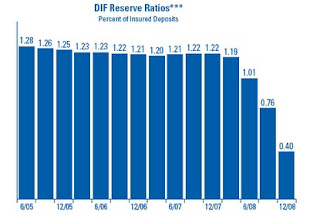
As outlined in the post above, this declining reserve ratio has (according to some) left the FDIC ill prepared to deal with the likely raft of upcoming bank failures. As you can see from the chart, the reserve ratio was at 0.40 percent as of December 31, 2008, down from an already low 1.01 percent level and below its legally mandated funding level of 1.15 percent.

And as Mish points out, these figures don't even take into account the FDIC's temporary boost in bank account coverage to $250,000. So, isn't that a bit of a problem, especially since more bank failures are expected throughout the year?

Well, not really, according to Bankrate.com. In an October 16, 2008 article entitled, "How the FDIC pays for bank failures" (which I just happened to be reading the other day while reading up on bank insurance), Bankrate's Laura Bruce explains that the money will just have to come from the US Treasury:

"...Christopher Whalen, co-founder and managing director at Institutional Risk Analytics, as well as a writer and former investment banker, says the FDIC will always be able to reimburse customers for their insured deposits.

"The FDIC is like any federal agency; the government runs on cash. Money comes in and money goes out and each of these little funds gets a piece of paper that says I owe you money plus accrued interest. But really, in most cases, it just evidences legal authority to spend money. In the case of the FDIC, it merely evidences funds paid in by the industry, minus losses. But it's still just a theoretical balance because it doesn't reflect at all the cash available to the agency to fund resolutions."

As long as the FDIC has a positive balance in the fund, the agency is just asking for the industry's money back. If that money is gone, the FDIC runs a tab at the Treasury because, by law, it has borrowing authority.

Traditionally, the FDIC's borrowing authority at the Treasury is limited to $30 billion, but Congress bestowed unlimited borrowing authority temporarily as part of the Emergency Economic Stabilization Act of 2008."

So there you have it. It's all good; if there's not enough money in the till, they'll just get the money from the Treasury. But where does the Treasury get the money from?

In the meantime, small banks are feeling the pinch from special assessment fees that the government wants to levy on them for the purpose of refilling the FDIC coffers. Note the irony: a large percentage of those funds were spent last year dealing with the failure of large banks like IndyMac.

Meanwhile, the FDIC collected no insurance premiums from most banks from 1996-2006.

Given all the recent information about the agency's precarious financial condtion, the question becomes: who will bail out the FDIC if it becomes insolvent?

Tuesday, April 21, 2009

Jim Rogers interview at Barron's Online

Haven't had a chance yet to take a good look at this week's Barron's, but I do know that there is a new Jim Rogers interview at Barron's Online, thanks to a post at the Lew Rockwell blog.

Here's an excerpt from that piece:

"Recently, Rogers talked to Barrons.com by phone from his Singapore home.

Q: When you last did a lengthy interview with Barron's magazine a year ago (see "Light Years Ahead of the Crowd," April 14, 2008) you were lightening up on emerging markets investments. Well, you called that one right. But now that many of those markets have fallen from their highs of recent years, are you more optimistic?

A: No. I've sold all emerging markets stock except the ones in China. I bought more Chinese shares in October and November during the panic, but I have not bought China or any other stock markets including the U.S. since then.

I'm not buying anything in China right now because the Chinese market ran up maybe 50% since last November. It's been the strongest market in the world in the past six months and I don't like jumping into something that has been that run up. Still, I'm not thinking of selling these stocks either. I think if it goes down I'll buy more. I think you will find that it's the single strongest market in the world since last fall."

Good stuff, and there is more on Rogers' continued fondness for the commodity sector, the outlook for US bonds, and his thoughts on China's rise to power and prominence on the world stage, and what that could mean for investors and young people today.

Speaking of Jim Rogers and China in the 21st century, if you haven't already seen Rogers' recent interview with UK Channel 4, I highly recommend it. Check it out when you have a few moments to spare.

Monday, April 20, 2009

US puts conditions on bailout repayments

The Financial Times reports that the US will put conditions on TARP bailout repayments from banks who say they are ready to pay back the government.

"Strong banks will be allowed to repay bail-out funds they received from the US government but only if such a move passes a test to determine whether it is in the national economic interest, a senior administration official has told the Financial Times.

“Our general objective is going to be what is good for the system,” the senior official said. “We want the system to have enough capital.”

His comments come as Goldman Sachs, JPMorgan Chase and other relatively strong banks are pressing to be allowed to repay their bail-out funds..."

Pretty amazing, isn't it? Some of these banks were strong-armed into taking TARP funds in the first place (so as not to "stigmatize" banks that truly needed the money).

Now the government is trying to control the repayment schedule of said funds, or at least give the impression that they are successfully directing the economy and driving a shattered industry to act in the "national interest" by providing "credit to support the recovery", etc.

Is the government simply trying to maintain control over the troubled banking industry, or are conditions on TARP repayments a way to ensure that all banks look the same (with none visibly stronger or weaker than the others) in the eyes of the public?

Naked Capitalism has some additional commentary on the issue of TARP repayments, and Paul Kedrosky offers up this chart of the S&P 500 financials which illustrates how well the industry has done in recent months, thanks largely to taxpayer funded bailouts (H/T to Howard Lindzon).

Related articles and posts:

1. Jamie Dimon eager to pay back TARP funds - Finance Trends.

2. William Black: "stress tests are a farce" - Finance Trends.

3. Nationalization in Denial? - Naked Capitalism.